




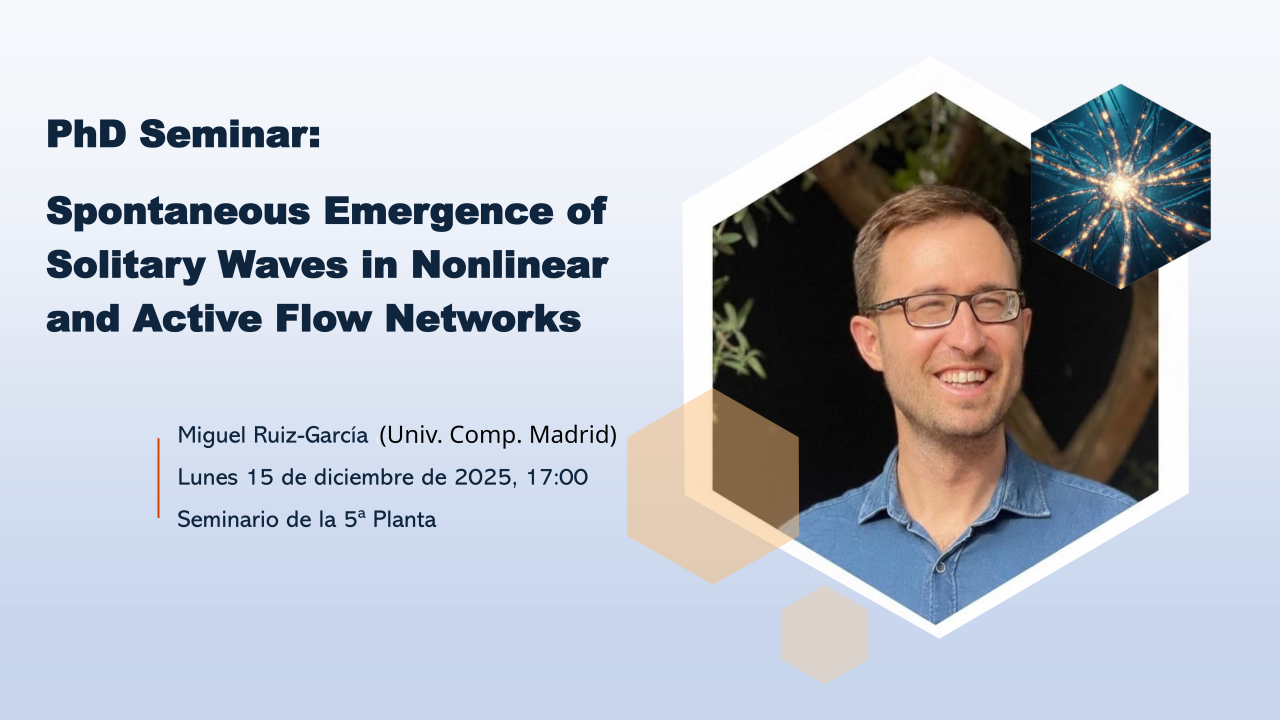
Speaker: Dr. Miguel Ruiz García (Ramón y Cajal postdoc at Universidad Complutense de Madrid).
Title: "Spontaneous Emergence of Solitary Waves in Nonlinear and Active Networks".
Date and time: Monday, 15th of December 2025 / 17:00 - 18:00.
Place: Seminar room at 5th floor of the Physics Building (Reina Mercedes campus).
Abstract:
Flow networks are fundamental for understanding systems such as animal and plant vasculature or power distribution grids. These networks can encode, transmit, and transform information embodied in the spatial and temporal distribution of their flows. We have explored flow networks that incorporate valves or elements exhibiting nonlinear relationships between flow rate and pressure drop. These elements act as interacting degrees of freedom, enabling the emergence of collective phenomena. We have shown that when such elements operate in a regime of negative differential resistance, the network can exhibit memory even at zero Reynolds number [1]. Increasing complexity gives rise to additional behaviors, including pattern formation, excitability, and self-sustained oscillations [2]. In this talk, we focus on a minimal yet physically grounded system that allows us to isolate the fundamental mechanisms by which active flow networks generate and regulate emergent dynamics capable of supporting information transmission. The system is composed of active units that pump fluid and elastic units that store volume. From first principles, we derive a discrete model—an active flow network—that enables the simulation of large systems with many interacting units. Numerically, we show that the pressure field can develop solitary waves, resulting in the spontaneous creation and transmission of localized packets of information stored in the physical properties of the flow. We characterize how these solitary waves emerge from disordered initial conditions in a one-dimensional network, and how their size and propagation speed depend on key system parameters. Finally, when the elastic units are coupled to their neighbors, the solitary waves exhibit even richer dynamics, with diverse shapes and finite lifetimes that display power-law behaviors that we can predict analytically [3].Together, these results show how simple fluidic elements can collectively create, shape and transport information, laying the foundations for understanding—and ultimately engineering—information processing in nonlinear flow systems.
References:
[1] Martínez-Calvo, A., Biviano, M. D., Christensen, A. H., Katifori, E., Jensen, K. H., & Ruiz-García, M. (2024). Nature Communications, 15, 3121.
[2] Ruiz-García, M., & Katifori, E. (2021). Phys. Rev. E, 103, 062301.
[3] Fernández-Quevedo García, R., Cruz Antunes, G., Harting, J., Stark, H., Valeriani, C., Brandenbourger, M., Mazo, J. J., Malgaretti, P., & Ruiz-García, M. (2025). arXiv:2511.13448.
BIO:
Miguel is a Ramón y Cajal Assistant Professor at Universidad Complutense de Madrid, working on soft matter physics—particularly flow networks—and deep learning. He coordinates an international HFSP project on collective behavior and is co-PI of a Spanish national project on nonequilibrium phenomena. Before joining UCM, he was a Conex-Plus Marie Skłodowska-Curie fellow at UC3M and an Assistant Professor at UPM, following a postdoctoral stage at the University of Pennsylvania. He completed his PhD at UC3M after studying Physics at the Universidad de Sevilla where he received the award to the best student in the class of 2012.